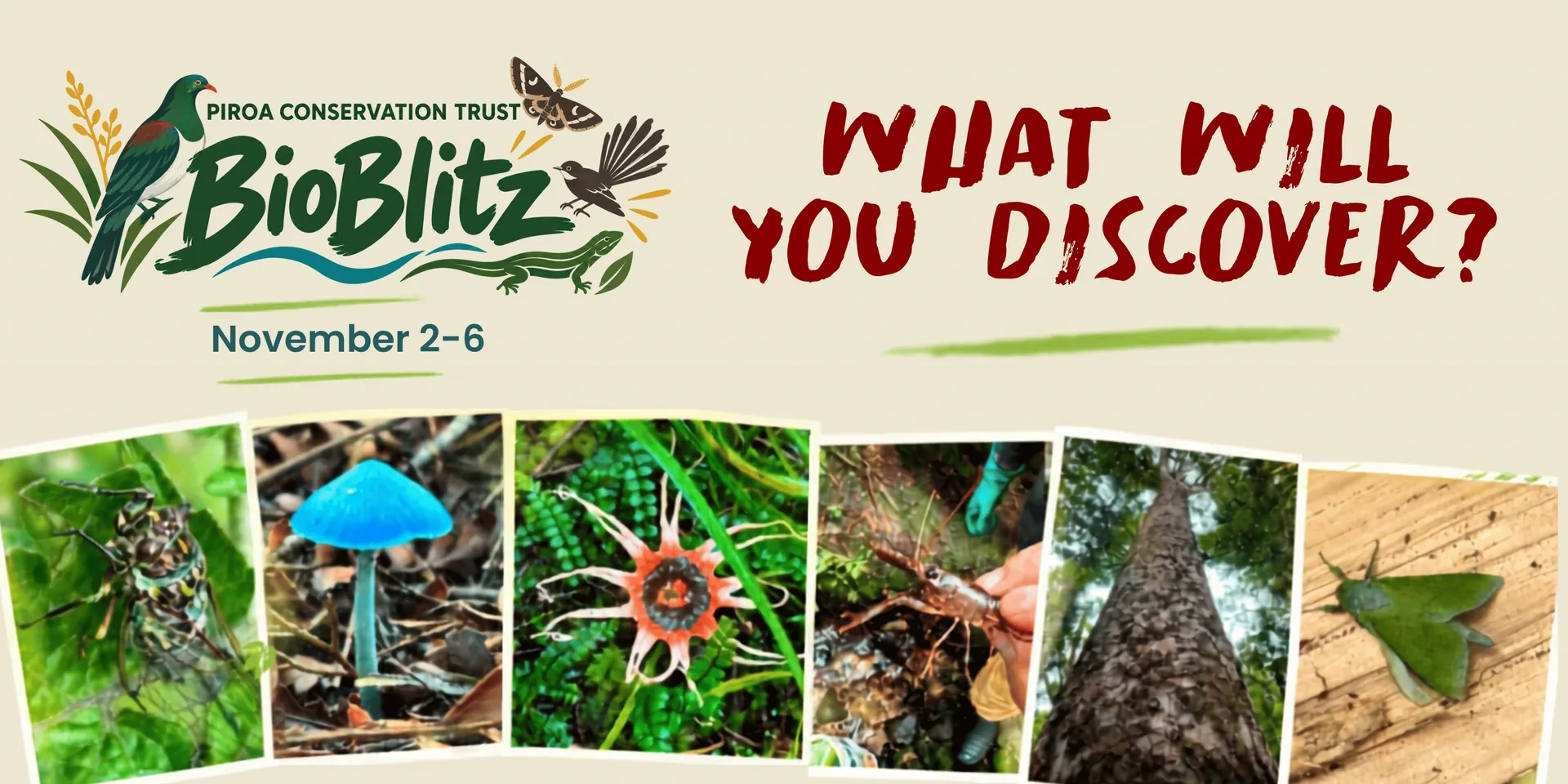
2–6 November 2026
Join the BioBlitz!
Help us discover the incredible plants and animals living on our doorstep…
From Monday 2 to Friday 6 November 2026, we are planning the first landscape-scale BioBlitz across the Piroa-Brynderwyn landscape, and we would love our community to be part of it.
The BioBlitz is being coordinated by Piroa Conservation Trust in partnership with Pātuharakeke, Te Uri o Hau, Northland Regional Council and the Department of Conservation, alongside local landowners, landcare groups, schools, volunteers and species specialists.
Over five days, teams will survey forests and connected habitats throughout the Piroa–Brynderwyn landscape, working together to find, identify and record as many living species as possible.
The week will include surveys for birds, plants, fungi, skinks and geckos, freshwater species, invertebrates, kauri snails and other species living within our forests, streams and wetlands. Some monitoring is already underway, while other seasonal surveys, including those for pēpeketua and ōi, will take place at the appropriate time of year and contribute to the wider ecological baseline.
We will be joined by ecologists and species specialists from Northland and further afield, who are generously sharing their time and knowledge. It is a rare opportunity to walk alongside people who have spent years learning how to find and understand species that most of us would pass without even noticing.
But you don’t need to be an expert to join us. The BioBlitz is about learning together, sharing what we already know about this landscape, adding new observations and giving more people the skills and confidence to recognise the plants and animals around us.
The information gathered will help the project partners, landowners and local communities make better-informed decisions about conservation across the landscape. Before we can care for an important habitat, we need to understand what depends upon it. And if we want to know whether our work is making a difference, we need a clear picture of what is here now.
Register Now!
There will be a range of opportunities for people to take part, from accessible community activities to more specialised field surveys. Numbers and access may be limited for some activities, particularly where surveys take place on private land.
We will publish the full programme and further information as plans are confirmed, so please keep checking this page for updates.
Thanks to Lottery Environment and Heritage for their support.
Frequently Asked Questions
What’s happening?
The BioBlitz will run over five days, from 2–6 November 2026 (rain date, for bad weather: 16–20 November). It will involve experts, mana whenua, conservation groups, volunteers, schools and the community, looking for everything from birds, plants and insects to reptiles, freshwater life and fungi.
What is a BioBlitz?
A BioBlitz is a community-based wildlife survey where people work together over a set period of time to find and record as many different species as possible in a particular area. A BioBlitz turns discovering nature into conservation action — building knowledge, connecting people and helping us make better decisions about protecting our living environment.
Where will it take place?
We’re focussing on different species and habitats within the Piroa-Brynderwyn High Value Area (HVA) — around 2,300 ha from Mangawhai in the south, and Langs Beach and the Bream Tail coast in the north.
What will the BioBlitz achieve?
For decades landowners, hapū, volunteers, and conservation groups have been undertaking pest control, habitat restoration and kiwi recovery work in the area. More recently, we’ve been talking about how we can co-ordinate our efforts to help restore biodiversity in the Piroa-Brynderwyns, based on the idea of a virtual or open sanctuary, as a way of taking a more joined-up approach to protecting and enhancing the area’s biodiversity.
The BioBlitz will give us a good picture of the species living in the area, so we know where to focus our conservation efforts. It will help us:
- Build our knowledge, creating a snapshot of what species are present and where they are found.
- Discover new species that haven’t previously been recorded.
- Identify important habitat, highlighting places that need protection.
- Track change over time — starting with this baseline survey.
A BioBlitz is also a great way for people to connect with nature — to observe the wildlife living around us and to understand why it’s important to protect them.
Who is involved?
- Piroa Conservation Trust
- Coordinating the BioBlitz programme, bringing partners and landowners together, and turning the findings into restoration decisions.
- Pātuharakeke and Te Uri o Hau
- Cultural partners, each shaping the kaupapa on its own whenua. Responsible for identifying many of the target species.
- Northland Regional Council
- Delivery partner. Technical advice, specialist staff and contractors, and help with survey design.
- Department of Conservation
- Monitoring standards, existing species data, and providing 2–3 rangers during the week.
- Landowners
- Access and local knowledge.
- The community – schools, volunteers, conservation partners…
- We’re hoping to get as many people as possible involved in the fieldwork during the week, assigned to one of our survey teams: birds, wetland birds, coastal and seabirds, plants and forest health, lizards, freshwater life, invertebrates and moths, or fungi.
What are we looking for?
The species on this list were chosen together with our partners. Pātuharakeke and Te Uri o Hau identified many of the target species, drawing on their knowledge of and relationships with their whenua. Northland Regional Council’s biodiversity team and the Department of Conservation advised on species of ecological importance, existing records, and the survey methods and timing needed to find them.
- Kiwi
- Acoustic call counts on dark-moon nights. Running since 2022, alongside the BioBlitz.
- Kūkupa/wood pigeon, kākā, korimako/bellbird, miromiro/tomtit, kākāriki, pīwakawaka/fantail, riroriro/grey warbler
- Five-minute bird counts, timed to the spring territorial song peak.
- Mātātā / fernbird
- Call playback on wetland and riparian margins.
- Matuku hūrepo/bittern
- Booming counts on full-moon nights, alongside the national Matuku Muster.
- Manu moana and the coastal margin
- Coastal breeding surveys along the northern coastal margin, with an avian influenza watch. Methods and timing being settled.
- Kauri
- Vegetation plots and dieback surveillance.
- Rātā, threatened plants and orchids
- Timed searches at flowering. Indicators of soil, moisture, elevation and forest condition.
- Werewere-kōkako and fungi
- Fruiting-body foray, after autumn rain.
- Mokomoko / ngārara, skinks and geckos
- Cover objects, pitfalls and night spotlighting. Detection is best in warm, dry conditions, so this work carries on past the BioBlitz week.
- Tuna, especially longfin, and stream health
- Fyke netting in warm water, alongside a mauri assessment carried out with hapū.
- Pekapeka
- Acoustic monitors. The full survey was completed in February 2026 and stands as the baseline. The lesser short-tailed bat is still to be checked for.
- Pūpūrangi / kauri snail
- Night searches, triggered by rain rather than by a date. Method to be confirmed.
- Invertebrates, including moths
- Method to be confirmed.
- Pigs and deer
- Sign, cameras, and an eDNA diet study already underway.
At the same time we will be carrying out our regular predator monitoring activities, the results of which will be included in those of the BioBlitz. Some species, like the ōi/grey-faced petrel and pepeketua, will be surveyed outside the BioBlitz window.
How can I get involved?
We’ve got to cover a lot of ground in a short space of time so we need all the help we can get. We’re looking to involve as many people as possible from our community: schools, community groups, families and individuals. We need as many curious eyes as possible.
Register your interest here to join one of our survey teams →
If you own land within the survey area and you’d like to know what’s there, get in touch with us. Email katie.gibb@piroaconservation.org.nz